In this video, Sara Kekuš, Coordinator of Protecting and Promoting the Right to Asylum and Migration programme, and Lucija Mulalić, from the Supporting an Inclusive Society Programme at Centre of Peace Studies, Zagreb, speak to us about the evolution of migration control at the “external” EU border in Croatia since 2013.
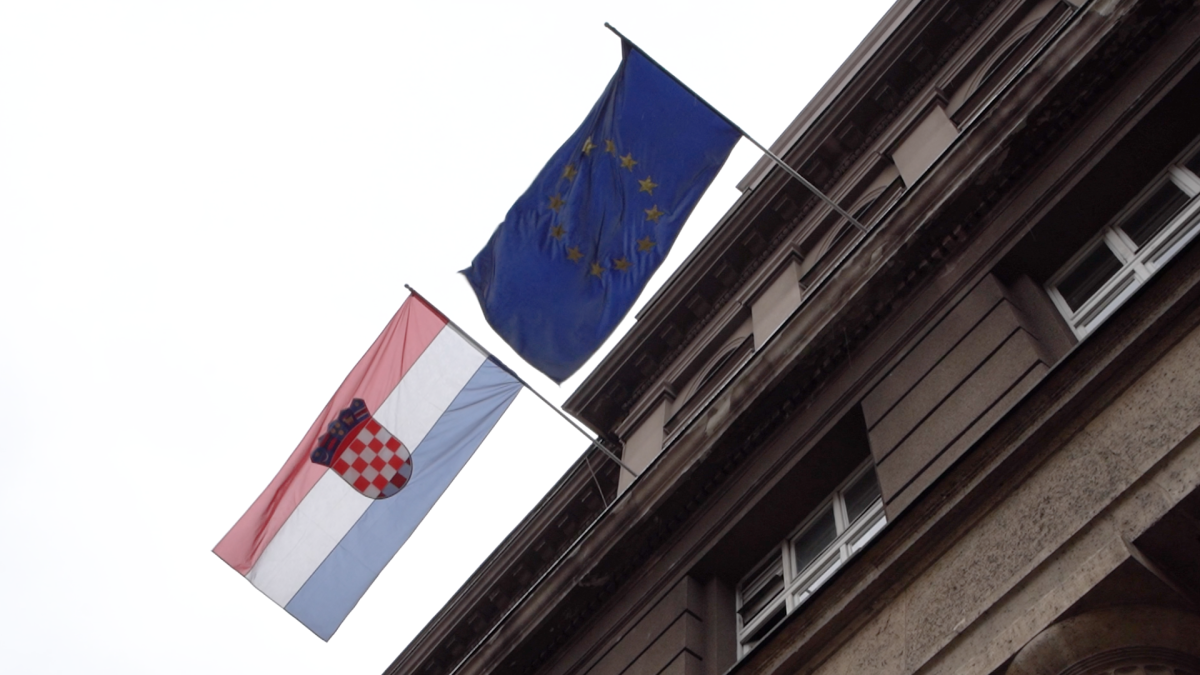
In 2013, Croatia entered into the European Union and the Schengen Border system. Throughout the following decade, they began to hold a newly marked position as “defender” of the “external” European border against people on the move entering Europe to seek asylum through the Balkan Route from the Middle East, Asia and Africa. In 2015, the “external” border in Croatia started out as a transit corridor to North-Western Europe following the entry of higher numbers of refugees from Syria into Europe through the Balkan Route. The corridor moved to Croatia after Hungary put up a fence on its border with Serbia, then on from Croatia to Slovenia where people were transferred with trains and buses to the northern border with Austria, towards Germany. From this moment onwards, Croatia became a local Balkan power “in charge of restoring the European border regime on behalf of EU core states and powers” (Beznec and Kurnik 2020).
In 2015 and 2016, people on the move through Croatia were perceived as transitory, and solidarity and assistance at Croatian borders was more stable, reliable and possible. However, as the decade went on, Croatia’s main goal became that of stopping migration into the EU, and structured acts of solidarity that facilitate it, with police-led intimidation and increasingly violent and obstructive border practices. The opened corridors, and the solidarity practiced within them, have been gradually closed and restricted from 2016, with State Authorities in Croatia, Serbia, Bosnia and Herzegovina fortifying their border infrastructures and relying “heavily on racializing practices and the mobilization of racist sentiments in the public sphere” (Beznec and Kurnik 2020).
At an infrastructural level, border zones are being heavily developed through the construction of fences and the deployment of new technologies. In countries such as Bosnia and Herzegovina and Serbia, access to development funds is increasingly conditioned on each state’s willingness to act as a buffer or “temperate” zone for migration. The EU’s external border in Croatia has also become increasingly known for the use of illegal pushbacks, a core practice of the EU border regime that refers to the informal expulsion of individuals or groups to another country without due process. This practice stands in contrast to deportation, which is carried out within a legal framework.
At the same time, on a narrative level, public debates have shifted significantly. People who were widely perceived as refugees in 2015 are now increasingly portrayed as “illegal migrants” who allegedly have no right to asylum. The securitisation of people on the move – and their growing association with terrorism and danger – has intensified, fuelling higher levels of xenophobic and racist violence in public spaces and contributing to increasingly negative perceptions of migration as a deeply human and long-standing phenomenon.
This video and article was developed within the framework of Lives in Motion, a non-formal educational project created by Maghweb in partnership with CPS, WWF and Polylogos, funded by the EACEA in the CERV strand European Remembrance.
Bibliography