“[Migrations] weren’t something I think about everyday… But now I realise this has to change.”
Student from Dubrovnik Economy and Trade School
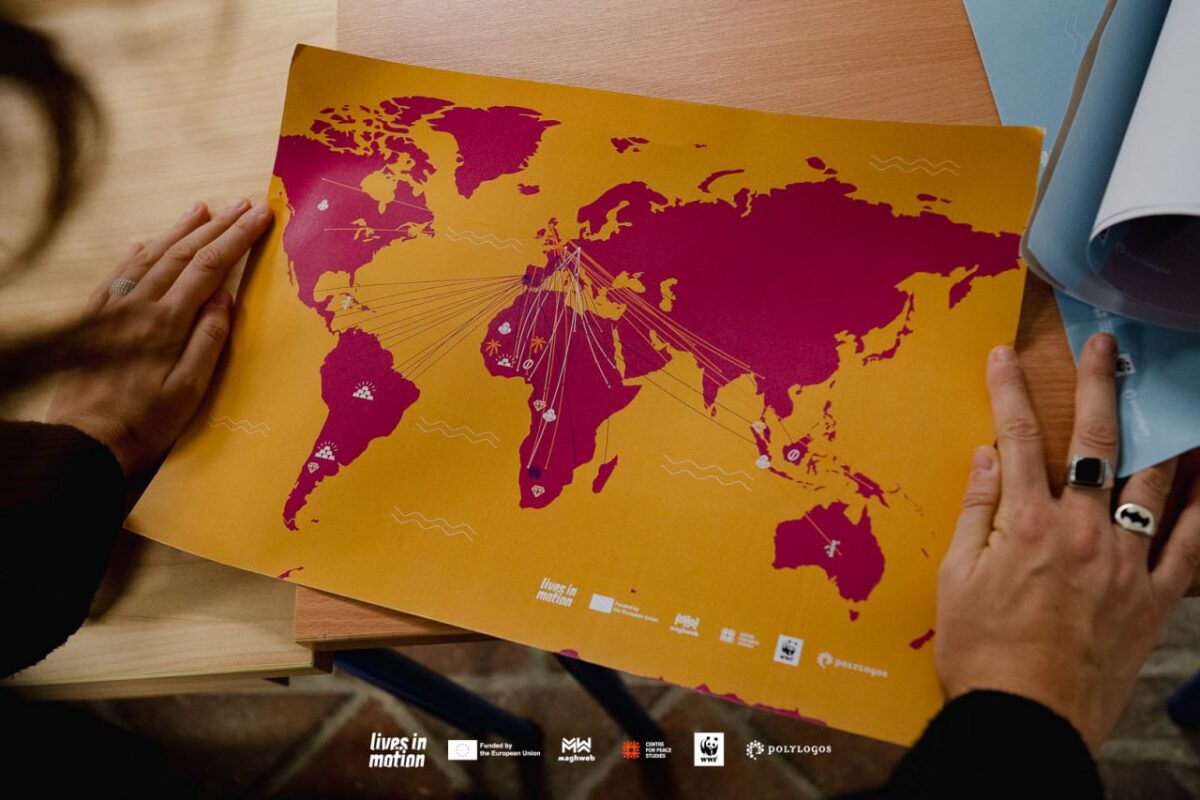
Last week, 18-21 November 2025, a group of diverse high school students living in Zagreb and other parts of Croatia played the long-awaited “Lives in Motion: The Game”, facilitated by the tool’s team of non-formal educators. The Game, which invites players to enact and deconstruct the positions of power that are formed in different scenarios of migration into, out of and within Europe, was introduced into schools during Global Education Week, where pedagogues and teachers are aiming to “promote societal awareness, active citizenship, and students’ understanding of their own starting positions in the world in relation to others” (Pedagogue, X Gymnasium).
The game was well received in learning contexts which usually lack the time or tools to break down barriers of discrimination (Pedagogue, X Gymnasium); enabling students to start understanding the interrelatedness of mobility, political and civil rights, history and power. It also stimulated students to explore, constructively and empathetically, their own position in relation to migration phenomena in Croatia, from its recent and contemporary histories as a departure point for emigration to its current controversial role in controlling migrations into the EU with an exponentially violent “border regime” (Rass and Wolff 1920).


Many thanks to XVIII Gymnasium, Private Art Gymnasium, X. Gymnasium, Tehnička škola za računalstvo i mrežne djelatnost and Ekonomska i trgovačka škola Dubrovnik for their collaboration. After making all last minute changes, the game will be available online in downloadable format from 10/12/2025, the International Human Rights Day.
The initiative was part of Lives in Motion, a non-formal educational project created by Maghweb in partnership with CPS, WWF and Polylogos, funded by the EACEA in the CERV, strand European Remembrance.